| Quick Answer: Because of a mismatch the grid calls the duck curve: California’s enormous solar fleet floods the state with cheap power at midday, then production collapses at sunset just as households come home and demand surges. Utilities must ramp expensive, fast-responding generation to fill that gap, and time-of-use rates pass the cost through — which is why the 4–9 PM window runs 35 to 62 cents per kilowatt-hour while midday power is nearly worthless. A home battery is the household-scale answer: store the cheap midday hours, spend them in the expensive evening. |
Every Californian on a time-of-use plan has felt it: run the dishwasher at noon and the meter barely notices; run it at 6:30 PM and you are paying some of the most expensive residential electricity in America. This is not arbitrary, and understanding the mechanics behind it is the fastest way to understand why batteries — utility-scale and household-scale — have become the center of California’s energy story.
What Is the Duck Curve?
Plot the state’s electricity demand minus its solar and wind output across a day, and the resulting “net load” line sags deep in the middle of the day — when solar is producing furiously — then rockets upward at sunset. The silhouette looks like a duck, and the U.S. Energy Information Administration has documented the curve getting deeper year after year as California adds solar: ever-cheaper middays, and an ever-steeper evening climb for the grid to serve.
Why Does Sunset Create a Price Spike?
Because two lines cross in the wrong direction at the same hour. Solar output falls off a cliff as the sun drops — and at that exact moment, people arrive home, air conditioners fight the accumulated heat of the day, ovens light, and EVs plug in. The grid must replace gigawatts of vanishing solar and meet surging demand simultaneously, using generation that can spin up fast. Fast, dispatchable power is expensive power, and evening rates reflect what those hours genuinely cost to serve.
Why Do Utilities Charge So Little for Midday Power?
Oversupply. At solar noon California frequently produces more renewable power than it can use, and surplus midday energy is worth very little — the same dynamic that sets exported rooftop solar’s compensation under NEM 3.0 at roughly 5 to 8 cents per kilowatt-hour. The price signal is brutally consistent from the wholesale market down to your rate plan: daytime energy is abundant and cheap, evening energy is scarce and dear, and the gap between them is where the money moves.
Is This Getting Better or Worse?
The pressures are growing. Data centers, EV adoption and building electrification are all adding load — much of it in the evening — while the solar fleet keeps deepening the midday trough. California’s structural answer is storage at every scale: the state has already built over 21,000 megawatts of battery storage because shifting solar energy to when it is actually needed is the fastest, most flexible fix, and utilities are adjusting rates and interconnection rules around that reality. The evening premium is not a temporary quirk; it is the shape of the system now.
What Can a Homeowner Actually Do About It?
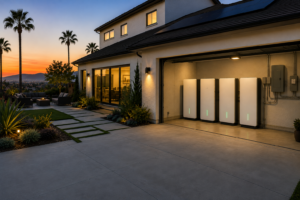
Run the state’s playbook at house scale. A home battery charges on cheap, abundant midday energy — your own solar if you have panels, off-peak grid power if you do not — and discharges through the 4–9 PM window, so your household simply stops buying electricity during the five most expensive hours of the day. For solar owners under NEM 3.0 the logic doubles: instead of exporting midday generation for 5–8 cents and buying it back at up to 62, you keep the full retail value of your own power. How much that is worth for your specific home depends on your utility, your tariff and your usage — the three things a recent utility bill reveals precisely, alongside whatever utility programs your territory currently offers.
How Do PG&E, SCE and SDG&E Differ at Peak?
The shape is identical; the severity varies. All three big investor-owned utilities concentrate their highest prices in the same post-sunset window, but the numbers differ: SDG&E’s summer peak reaches 62 cents per kilowatt-hour — the steepest in the state — while PG&E and SCE run roughly 52 to 59 cents on most time-of-use plans. Season matters too, with summer peaks outrunning winter ones, and each utility offers multiple rate plans whose peak windows and prices differ from one another. Two neighbors on the same street, with the same utility, can face meaningfully different evening prices purely because of the plan each is on.
That variation is why generic savings claims are useless and why the analysis has to be personal. The severity of your utility’s peak sets the ceiling on what a battery can save you each evening; your specific rate plan sets the actual spread; and your household’s 4–9 PM consumption sets the volume. All three facts sit on one document — which is why every honest battery conversation in California starts with a recent utility bill rather than a statewide average.
Frequently Asked Questions
What hours are peak in California?
Typically 4 to 9 PM on time-of-use plans — the window where solar has stopped producing and household demand is at its highest, with rates of 35 to 62 cents per kilowatt-hour depending on utility and season.
What is the duck curve in simple terms?
The day’s net demand on the grid: low at midday when solar floods the system, spiking at sunset when solar quits and everyone gets home. The shape resembles a duck — and it is why evening power costs so much.
Why is my exported solar worth so little?
Because it is delivered at the hours when the grid is already drowning in solar. NEM 3.0 compensates exports at roughly their value to the grid — about 5–8 cents — which is the market saying midday energy is abundant.
Will evening rates come down as more batteries get built?
The state is betting on storage to flatten the curve, but rising evening demand from EVs and electrification pushes the other way. Rates are a moving target; the midday-cheap, evening-dear structure is durable.
Does a battery really let me skip peak rates entirely?
A correctly sized battery covers your household’s typical 4–9 PM consumption, so peak-hour purchases fall toward zero on normal days. Sizing to your real evening load — from your bill — is what makes that true.
Ready for a straight answer? Send Solari Storage a recent utility bill and find out exactly what a battery would do for your home — including if the numbers say don’t buy. Contact Solari Storage for a free assessment.
Key Takeaways
- Evening electricity is expensive because solar collapses at sunset exactly as household demand surges — the duck curve.
- Midday power is abundant and nearly worthless; 4–9 PM power is scarce and costs 35–62¢ — the same signal that sets NEM 3.0 exports at 5–8¢.
- Growing evening loads from EVs, data centers and electrification mean the peak premium is structural, not temporary.
- California’s fix is storage at every scale — over 21,000 MW built — and a home battery runs the same playbook at house scale.
- Your personal version of the duck curve is on your utility bill: rate plan, peak prices, and evening usage.