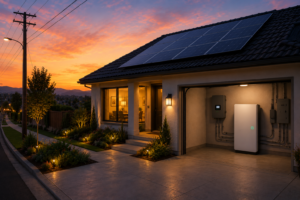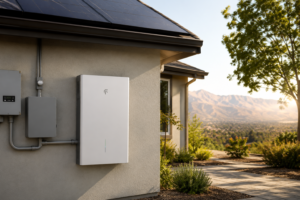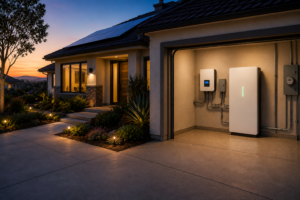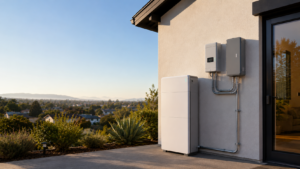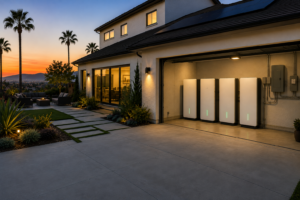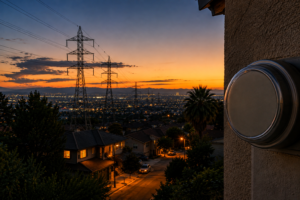
| Quick Answer: A home battery is the only practical way to keep a California house running during a Public Safety Power Shutoff, because grid-tied solar panels stop producing the moment the grid goes down. Solari Storage works with four battery platforms — Tesla Powerwall 3, Lunar System, FranklinWH aPower 2 and the SolarEdge Home Battery — and sizes the system from your real utility bill and the circuits you actually need backed up. Send us a recent bill and we will tell you plainly whether storage makes sense for your home. |
Every fall, California homeowners go through the same routine. The wind picks up, the utility sends a warning text, and somewhere between one evening and several days later the power comes back on. Public Safety Power Shutoffs are now a permanent feature of life in this state, and they land hardest in the months when hot, dry weather meets strong offshore winds. If you already have solar on the roof, you may assume you are covered. You are almost certainly not. This guide explains what a PSPS is, why panels alone go dark with everyone else, what a home battery keeps running, and what to sort out before the windy months arrive.
PSPS Season in California Peaks in the Windiest Months
A Public Safety Power Shutoff is a planned outage. When strong winds, low humidity and high fire risk line up, utilities switch off power to specific circuits so their equipment cannot start a wildfire. The California Public Utilities Commission ruled in 2012 that the state’s investor-owned utilities have the authority to de-energize lines to protect public safety, and the practice has expanded steadily since. Pacific Gas and Electric, Southern California Edison and San Diego Gas & Electric all run shutoff programs, along with several smaller utilities. You can read the state’s own overview of the program on the CPUC Public Safety Power Shutoff page.
This season carries an extra warning. Southern California Edison has said that shutoffs in 2026 could happen more frequently, affect more customers and last longer than usual, because fire risk is rising. If you have been treating a battery as a someday purchase, that is the sentence worth rereading.
The risk is not spread evenly across the year or across the map. The CPUC classifies areas by wildfire threat, and homes in the elevated and extreme risk tiers are the most likely to be shut off. The timing follows the wind: the Diablo winds in the north and the Santa Ana winds in the south arrive as the landscape dries out, which is why so many shutoff events fall between late summer and early winter. Utilities usually give notice by call, text or email a day or two ahead, then restore power once crews have patrolled the lines and confirmed no damage. That inspection is why a shutoff often outlasts the wind event that caused it.
Solar Panels Alone Will Not Power Your House During a Shutoff
This is the part that surprises people who have paid for a solar array. A standard grid-tied solar system is designed to shut itself down when the grid goes down. It is a safety requirement, and it protects line workers who may be repairing the very circuit your panels would otherwise be feeding. So on the sunniest afternoon of a three-day shutoff, a home with panels and no storage sits in the dark alongside every neighbor who never went solar at all.
Storage is what changes that. A battery gives your system somewhere to put the power and a way to disconnect safely from the grid, so the house keeps running on its own. Adding a battery to an array that already exists is usually the cheapest energy upgrade available in California. The panels are paid for, the roof work is done, and most existing systems can take an AC-coupled battery regardless of inverter brand or age. Compatibility gets checked before anything is quoted.
What a Home Battery Actually Runs During a PSPS
How long a battery carries your house depends on two things: how much usable capacity it has, and how much of the house you ask it to power. A battery covering essential circuits — refrigerator, internet, lighting, a few outlets, medical equipment — will stretch far longer than one asked to run central air conditioning, an electric range and a car charger at the same time. This is a sizing decision, not a brand decision, and it is worth making deliberately before an outage rather than during one.
Two numbers matter when you compare systems. Usable capacity, measured in kilowatt-hours, is how much energy the battery holds. Continuous output, measured in kilowatts, is how much it can deliver at once — that is what decides whether the air conditioner can start while the oven is on. A large battery with modest output will run a small load for a long time. A high-output battery will carry heavier loads but drain faster if you run everything. If the system is paired with solar and configured for it, the battery recharges during daylight hours, which is what allows a household to ride out a multi-day event rather than a single evening.
Comparing the Four Battery Platforms for Backup Power
Most companies sell one battery, so that is the one they recommend. Solari Storage works with four, which means the recommendation can follow the house rather than the inventory. For backup specifically, here is how they differ.
- Tesla Powerwall 3 — 13.5 kWh usable and 11.5 kW continuous output, the highest continuous output of the four platforms we work with. That matters in an outage because the battery can carry heavier household loads at once instead of forcing you to choose which circuits stay live. Its Storm Watch feature monitors weather data and charges ahead of forecast severe weather, so you go into an event full rather than half empty. More detail on the Tesla Powerwall 3 page.
- Lunar System — 15 to 30 kWh with 9.6 kW output. Capacity is modular, so the system is sized to your actual evening consumption instead of rounding up to a fixed block, and it can be expanded later if you add an EV or electrify your heating. Its load control lets you decide what stays powered during an outage rather than treating the house as one circuit.
- FranklinWH aPower 2 — 15 kWh with 10 kW output, and AC-coupled, so it works alongside most existing solar inverters rather than requiring them to be replaced. Units can be stacked, so larger homes can add capacity without switching systems. FranklinWH states a warranty of 15 years or 60 MWh of throughput, whichever comes first.
- SolarEdge Home Battery — 9.7 kWh with 5 kW continuous and 7.5 kW peak. Its DC-coupled design avoids a conversion step that costs efficiency in AC-coupled retrofits, and monitoring runs through the SolarEdge platform you are already using. The obvious choice if you already have SolarEdge equipment — with one caveat that matters in a shutoff: backup requires the SolarEdge Home Hub inverter and the SolarEdge Home Backup Interface, so an older SolarEdge inverter does not give you outage protection on its own. We check that before quoting.
There is no single best home battery for shutoff season. The deciding factors are your peak load, how much of the house you want backed up, the solar equipment already installed, your available space, and the incentives open where you live.
Backup Is Only Half the Value: The 4 to 9 PM Peak
A battery bought purely as an emergency generator is a battery working one week a year. The rest of the time it is doing something more valuable: keeping you off the grid during the most expensive hours of the day. Under NEM 3.0, the Net Billing Tariff, excess solar exported to the grid is worth roughly 5 to 8 cents per kWh, while evening peak rates commonly run from about 35 cents per kWh to 60 cents or more, depending on your utility and the season.
That gap is the whole argument. A solar-only system generates power at midday when nobody is home, sells it for almost nothing, then buys it back at four times the price when the family walks in the door. A battery charges on cheap midday solar and discharges through the 4 to 9 PM peak, so you get full retail value out of your own generation. Paybacks that stretched to 11 to 16 years for solar alone often land in the 7 to 11 year range with storage attached — and the backup power during shutoffs comes as part of the deal rather than as the sole justification for the spend.
What to Sort Out Before the Windy Months Arrive
Home battery storage in California requires a building permit and utility interconnection approval, and both are mandatory. Neither is quick, and neither can be started once the wind is already up. Solari Storage manages the permits, the schedule and the interconnection so you are not chasing your city’s permitting office or your utility, and a licensed contractor carries out the installation itself.
The practical sequence is straightforward. Send a recent utility bill so your real usage and rate plan can be read rather than estimated. Decide what must stay powered in an outage — that list drives the sizing more than anything else. Confirm your existing solar equipment is compatible. Then let the paperwork run while the weather is still calm. Households that start this in the quiet part of the year are the ones with a working system when the first warning text arrives.
Incentives and Costs for California Home Batteries in 2026
Be careful with anything you read on this subject, because a lot of it is out of date. The federal 30% residential clean energy credit under Section 25D expired after December 31, 2025. Cash and loan purchases in 2026 get no federal credit, and any company still quoting 30% on a purchase this year is wrong. SGIP, California’s state storage rebate, is not currently accepting general-market applications after its budgets ran out at the end of 2025.
What is left is utility-specific. Every California utility runs a different set of programs, and they open and close without much notice, which is why the honest answer to “what do I qualify for” always starts with your bill and your utility rather than a general figure. The current position is kept up to date on the Solari Storage incentives and rebates page. As for cost, the main variables are usable capacity, how much work your electrical panel needs, and how far the battery sits from it — which is why a price quoted without your bill attached is a guess, not a quote.
Frequently Asked Questions
How long will a home battery last during a PSPS?
It depends on the usable capacity of the battery and how much of the house you back up. Essential circuits such as the refrigerator, lighting, internet and medical equipment stretch a battery much further than whole-home backup running air conditioning and an electric range. If the battery is paired with solar and configured to recharge during an outage, it refills each day, which is what carries a household through a multi-day shutoff rather than a single evening.
Will my existing solar panels work with a battery?
Usually yes. Most existing California solar arrays can take an AC-coupled battery regardless of inverter brand or age, and your panels do not need replacing. Compatibility is checked before anything is quoted, and you will be told if your system is one of the exceptions.
Do I need a permit to install a home battery in California?
Yes. Home storage requires a building permit and utility interconnection approval, and both are mandatory. Solari Storage manages both, along with the installation schedule, so you are not chasing your city or your utility. The installation itself is carried out by a licensed contractor.
Is the 30% federal tax credit still available for a battery in 2026?
No. Section 25D expired on December 31, 2025 under the One Big Beautiful Bill Act, so systems placed in service in 2026 do not qualify. The IRS treats the expenditure as made when installation is completed, not when you paid a deposit, so a 2025 deposit on a 2026 installation does not rescue the credit. Confirm your own tax position with a qualified professional.
Can I still get a battery installed before shutoff season peaks?
That depends on your city’s permitting queue and your utility’s interconnection timeline, which is why starting early matters more than anything else. The fastest thing you can do today is send a recent utility bill so the sizing, the compatibility check and the paperwork can begin in parallel.
Getting ready for this shutoff season?
Send Solari Storage a recent utility bill and we will read your real usage and rate plan, tell you which of the four battery platforms fits your house, and file the incentive paperwork on your behalf. Book your assessment here. If the numbers say do not buy, we will say so.
Key Takeaways
- A Public Safety Power Shutoff is a planned outage used by California utilities to prevent wildfires during high-wind, high-risk conditions, and shutoff events cluster in the dry, windy months.
- Grid-tied solar panels shut down during an outage as a safety requirement, so panels without storage leave you in the dark alongside everyone else.
- Runtime is decided by usable capacity and by how much of the house you back up — essentials last far longer than whole-home backup, and a solar-paired battery can recharge daily through a long event.
- The four platforms suit different houses: Powerwall 3 for the highest continuous output, Lunar for modular sizing, FranklinWH for AC-coupled retrofits, SolarEdge for existing SolarEdge equipment.
- Backup is only half the value — a battery also shifts cheap midday solar into the 4 to 9 PM peak, where rates commonly run from about 35 cents per kWh to 60 cents or more against export credits of roughly 5 to 8 cents.
- The federal 30% credit expired after December 31, 2025 and SGIP is not taking general-market applications, so what you qualify for now depends on your utility — send a recent bill and find out what is actually open where you live.