| Quick Answer: The physical installation of a home battery is typically a single day of on-site work, but the full project from signed contract to switched-on system is dominated by permitting and utility interconnection rather than by the install itself. Solari Storage handles both, and tells you the expected sequence when we quote. Call (916) 507-1626 to talk through the timeline for your jurisdiction. |
Homeowners generally assume a battery project is limited by the installer’s schedule. In California it is limited by two administrative processes that run on their own timetables and vary considerably by city and by utility. Knowing that at the start changes the experience from frustrating to predictable. This article sets out the five stages of a battery project, what determines the length of each, and where the real delays sit.
What Are the Stages of a Battery Installation?
A home battery installation in California runs through five stages in sequence. First a review of your actual utility bill, which establishes your tariff, usage shape and the right system size. Second an honestly sized system recommendation. Third permitting and interconnection. Fourth the installation. Fifth handover with monitoring set up.
Most of the calendar sits in the third stage. The first two are measured in days, the fourth is often a single day, and the fifth is an afternoon. Our how it works page describes each stage in more detail, and our FAQ answers the timing questions we are asked most.
- Utility bill review and load assessment
- System sizing and quotation
- Building permit and utility interconnection application
- Physical installation and electrical inspection
- Commissioning, handover and monitoring setup
How Long Does the Physical Installation Take?
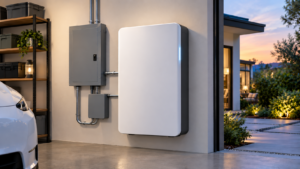
Physical installation of a straightforward single-battery system in a California home typically takes one day. The battery is mounted, conduit and conductors are run to the service panel, disconnects and labelling are fitted, and the system is wired for its designed backup scope.
Longer installs are almost always driven by electrical work rather than the battery. A main panel upgrade, a new subpanel for backed-up circuits, or a long run between the battery location and the panel each add time. These are identified during the site survey, so they should be known before installation day rather than discovered on it.
Why Does Permitting Take Longer Than the Install?
Permitting takes longer than the installation because two independent organisations have to review and approve the work, and neither operates on your installer’s schedule. Your city or county issues the building permit; your utility grants interconnection and, eventually, permission to operate.
Some California jurisdictions run streamlined electronic permitting for residential storage and turn applications around quickly. Others take weeks. Utility interconnection queues vary independently of that. Because the two processes are separate, delays in either extend the project, and neither can be accelerated by paying more.
What Can Delay a Battery Project?
The common causes are predictable and mostly identifiable in advance. Incomplete permit applications requiring resubmission. Panel upgrades discovered late. Equipment availability. Inspection scheduling in busy jurisdictions. Interconnection review that touches an existing net metering agreement.
The last of these matters particularly for retrofits to existing solar, because the review can interact with the tariff you are currently on. Working that out before the design is finalised avoids the worst kind of delay — the kind that arrives after the equipment is already on the wall.
Does a Retrofit Take Less Time Than a New System?
The installation is shorter, because there is no array to mount and no roof work. The permitting is not necessarily shorter, because a retrofit still requires its own building permit and generally its own interconnection application.
So a retrofit compresses the physical stage but not the administrative one. Homeowners with existing panels sometimes assume the array’s existing permissions carry over to the battery. They do not, and planning on that basis leads to disappointment.
When Does the System Actually Start Saving You Money?
When permission to operate is granted and the system is commissioned — not when it is installed. A system physically on the wall but awaiting utility authorisation should not be operating grid-interactively.
That is the practical reason the interconnection stage matters as much as it does. It is also why we prefer to set expectations about the whole sequence at quoting rather than emphasising the install date alone. The California Energy Commission publishes background on how the state’s storage and interconnection framework fits together.
What Can You Do to Keep the Project Moving?
Homeowners can do more to keep a California battery project moving than they might expect. A good deal of the avoidable delay in a battery project comes from information arriving late, and most of that information sits with the homeowner rather than the installer.
Providing a recent utility bill promptly is the single most useful thing, because it drives sizing and sizing drives the permit drawings. Beyond that, clear access to the service panel for the survey, confirmation of where you are willing to have the battery sited, and a quick turnaround on signing documents all shorten the calendar. If you have existing solar, having the interconnection paperwork or at least the installer’s name to hand helps the interconnection review considerably.
The one thing that genuinely cannot be accelerated is the review queue at your city and your utility. Knowing that in advance is more useful than chasing it, because it lets you plan around a realistic date rather than an optimistic one.
- Send a recent utility bill early — it drives sizing and the permit drawings
- Give clear access to the service panel for the site survey
- Confirm your preferred battery location before design is finalised
- Turn signed documents around quickly to avoid queue slippage
- For retrofits, locate your existing interconnection paperwork if you have it
Frequently Asked Questions
How long from signing to switch-on?
Physical installation of a California home battery is typically one day, but total elapsed time from signing to switch-on is set by permitting and utility interconnection, which vary substantially by jurisdiction. Solari Storage gives you the expected sequence for your specific city and utility when quoting.
Can I speed up the permitting process?
You cannot directly speed up California permitting, though a complete and accurate application submitted first time avoids the most common cause of delay, which is resubmission. Some California jurisdictions offer streamlined electronic permitting for residential storage, which helps considerably.
Do I need to be home during the installation?
Someone generally needs to be home during a battery installation, because access to the service panel and the battery location is required. Solari Storage confirms access arrangements when the install date is scheduled.
Will my power be off during installation?
Your power will be off for part of the installation day while the connection to your main panel is made. It is a portion of the day rather than the whole of it, and Solari Storage tells you in advance so you can plan around it.
What happens at the handover?
At handover Solari Storage commissions the system, confirms it is operating on the correct settings for your California rate plan, sets up monitoring so you can see what it is doing, and walks you through how it behaves in an outage. That is generally an afternoon.
Need help now? Call Solari Storage on (916) 507-1626 or send us a recent utility bill and we will come back with real numbers for your house.
Key Takeaways
- Physical installation of a single battery is typically one day of on-site work.
- The full project timeline is dominated by building permitting and utility interconnection, not by the install.
- Permitting speed varies widely between California jurisdictions, and interconnection queues vary independently.
- Panel upgrades and long conduit runs are the main causes of longer installations, and are identified at survey.
- Retrofits shorten the physical stage but still need their own permit and interconnection application.
- The system starts saving money at permission to operate, not at installation.
- Get the expected timeline for your jurisdiction from Solari Storage.