| Quick Answer: Most California homes are served well by one battery sized to cover evening peak usage, and only households with heavy climate control, whole-home backup requirements or large intermittent loads genuinely need two or more. Solari Storage sizes from your actual utility bill rather than your roof, which frequently produces a smaller system than homeowners expect. Call (916) 507-1626 and we will work it out from your real usage. |
Battery sizing is where a lot of money gets wasted in California, almost always in the same direction. Homeowners assume that more capacity is safer, installers rarely argue with a bigger sale, and the result is storage that sits half-used most nights. The right number of batteries is determined by a fairly small set of facts about your household, and none of them is the size of your roof. Here is how to work it out.
What Actually Determines How Many Batteries You Need?
Your evening consumption sets the capacity, and your largest simultaneous load sets the power output. Those are two different requirements and a system has to satisfy both.
Capacity, measured in kilowatt-hours, is about how much energy you need to shift out of peak hours. Output, measured in kilowatts, is about how much you need at once — whether the system can start an air conditioner without stumbling. A household can need more output without needing more capacity, or the reverse, which is why a single headline number never answers this question properly.
- Total energy used during the peak window, typically four until nine in the evening
- The largest loads you need to run simultaneously
- Whether you want whole-home or essentials-only backup
- How much outage resilience you want without sun
- Whether an EV charges at home, and when
Is One Battery Enough for a Typical California House?
One battery is enough for a great many California households. A Tesla Powerwall 3 is published by Tesla at 13.5 kWh usable with 11.5 kW of continuous output — the highest continuous output in its class — and that combination covers the evening peak of a typical home comfortably.
Where one is not enough is reasonably predictable: large homes running central air conditioning through long summer evenings, households wanting whole-home backup rather than essential circuits, or homes with well pumps, pool equipment and EV charging stacked into the same window. Those cases are real, but they are the minority, and they should be identified from usage data rather than assumed.
How Does an Electric Vehicle Change the Calculation?
An electric vehicle changes home battery sizing more than any other single appliance. Charging an EV at home can draw as much as the rest of the house combined, and if it charges during peak hours it will dominate your battery sizing.
The good news is that EV charging is usually schedulable. Shifting it to off-peak overnight hours takes it out of the peak window entirely and often removes the need for additional storage capacity. That is a settings change rather than a hardware purchase, and it is worth doing before concluding you need a second battery.
Should You Size for Bills or for Outages?
Sizing for bill savings and sizing for outage resilience pull in different directions, and you should decide which is driving the purchase. Sizing for bill savings means covering the peak window on a typical day — beyond that, extra capacity earns nothing because it never discharges.
Sizing for outage resilience means covering your essential loads for as long as you want to survive without grid power, which is a different and often larger number if you want multi-day coverage without relying on solar recharge. Being explicit about which goal is primary avoids buying capacity that serves neither well, and it is the first thing Solari Storage establishes before sizing anything.
Does a Modular System Change the Answer?
A modular battery system changes how precisely you can land on the right size. Lunar Energy scales in increments rather than in whole units, which means you can size closer to your actual requirement instead of rounding up to the next full battery.
That matters most for households sitting awkwardly between one and two units of a fixed-capacity system — the case where a single unit is slightly short and two is substantially more than needed. Lunar was founded by a former Tesla Energy executive and states that its software optimises against your rate plan and the weather forecast, which is a further consideration where load shapes are irregular.
Can You Add Capacity Later?
Generally yes, and with modular systems it is straightforward by design. With fixed-capacity units, adding a second involves additional electrical work, potentially further permitting, and the cost of that work is not trivial.
So there is a genuine trade-off between starting conservatively and expanding, versus sizing correctly at the outset. Solari Storage sizes from evidence rather than from anxiety, and will tell you honestly which category your household falls into. The U.S. Department of Energy publishes general guidance on home energy storage that is useful background before you make the call.
Frequently Asked Questions
How many kWh does the average California home use per day?
Household consumption across California varies enormously with climate zone, house size and whether heating and cooling are electric, so a state average is not a useful sizing input. What matters for storage is how much of your daily total falls inside the peak window, which your utility bill shows.
Do I need a bigger battery if I have a large solar array?
You do not need a bigger battery just because you have a large solar array. Storage is sized to your evening consumption, not your midday production. A large California array simply means the battery fills earlier in the day.
Can two batteries run my whole house during an outage?
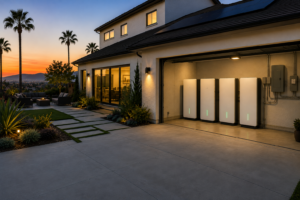
Two batteries substantially extend both capacity and output, which makes whole-home backup practical for many California households. Whether it is enough for yours depends on your climate control load, which is the dominant factor in whole-home outage performance.
Is it cheaper to buy two batteries at once or add one later?
Buying two batteries together is generally cheaper per unit than adding one later, because the electrical work, permitting and mobilisation are shared. That is only an advantage if you genuinely need the second unit — paying less per kWh for capacity you never discharge is not a saving.
What happens if I undersize the battery?
If you undersize a home battery you cover part of your California peak window rather than all of it, drawing from the grid for the remainder. That is a reduced saving rather than a failure, and it is generally a less costly mistake than oversizing.
Need help now? Call Solari Storage on (916) 507-1626 or send us a recent utility bill and we will come back with real numbers for your house.
Key Takeaways
- Capacity is set by evening consumption; output is set by your largest simultaneous load — a system must satisfy both.
- One battery covers the evening peak of a great many California homes, and oversizing is the most common costly mistake.
- EV charging can dominate sizing, but shifting it to off-peak hours often removes the need for extra capacity.
- Sizing for bill savings and sizing for outage resilience produce different answers — decide which is primary.
- Modular systems let you land closer to the right size instead of rounding up to a whole unit.
- Get sized from your real usage by Solari Storage at solaristorage.com/contact-us.