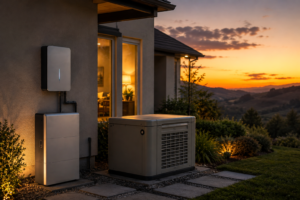
| Quick Answer: Usually yes, and it is normally the cheapest energy upgrade available in California. Most existing solar systems can take an AC-coupled battery regardless of inverter brand or age, so your panels do not need replacing. Solari Storage checks compatibility before quoting anything, and will tell you if your system is one of the exceptions. |
Most of the homeowners we work with already have solar. They bought it when exporting power to the grid was worth close to what they paid for it, the system has worked exactly as promised, and yet the savings have quietly shrunk. Nothing broke. The rules changed underneath the equipment. Adding storage to an array that already exists is the most direct fix, and it is far less disruptive than most people expect. Here is what actually happens when you retrofit a battery onto solar you already own.
Why Would You Add a Battery to a System That Already Works?
Because panels do not store anything. Your system produces most of its power in the middle of the day, when the house is usually empty. Production falls away around sunset, which is precisely when your most expensive hours begin and your whole family is home. So the power you generate at noon leaves your property, and the power you need at seven comes back from the utility at their price.
Under California’s Net Billing Tariff, commonly called NEM 3.0, exported power earns roughly 5 to 8 cents per kilowatt-hour, which is around 75 percent less than the old full retail arrangement. Evening peak rates, meanwhile, often run between 35 and 62 cents depending on your utility and the season. The CPUC’s own materials on the tariff describe the intent openly: the structure was designed to encourage customers to pair storage with rooftop solar. A battery is how you stop making the trade at the bad end of that spread.
Do Your Existing Panels Need to Be Replaced?
Almost never. This is the single biggest misconception we encounter, and it stops people from even asking the question. The panels are the part of your system with the longest life and the least to do with storage. Adding a battery does not require touching them in most retrofits.
The economics of this are worth sitting with. The panels are already paid for. The roof work is done. The permitting and interconnection for the generation side happened years ago. What is missing is somewhere to put the power until you need it, and that is a far smaller project than the original installation was.
What Is AC Coupling and Why Does It Matter for a Retrofit?
AC coupling is the reason most retrofits are straightforward. In an AC-coupled setup, the battery has its own inverter and sits alongside your existing solar inverter rather than replacing it. That means the battery does not need to be made by the same manufacturer as your original system, and your existing equipment keeps doing its job. The FranklinWH aPower 2 is AC-coupled for exactly this reason, which makes it a clean fit for homes with working solar already on the roof from any manufacturer.
The alternative is DC coupling, where the battery connects on the direct current side before conversion. It avoids a conversion step and so loses slightly less energy in the round trip, but it generally requires compatible equipment. If you already have a SolarEdge inverter, a DC-coupled SolarEdge battery becomes an efficient option. If you have something else, AC coupling is usually the sensible route.
Will Adding a Battery Affect Your Existing Net Metering Agreement?
This is the right question to ask, and it deserves a careful answer rather than a reassuring one. If you are on an older NEM 1.0 or NEM 2.0 agreement, that agreement has real value, because your exports are compensated far better than they would be under the current tariff. Anything that risks it deserves scrutiny.
Adding storage is treated differently from expanding generation, and the specific rules depend on your utility and on how the system is configured. This is not a place for a general reassurance from a salesperson. Ask your utility in writing what a storage addition does to your existing agreement, and make sure whoever designs your system understands which tariff you are on before anything is submitted. If your situation is one where the answer is not clean, you want to know that before you sign, not after.
How Much Disruption Does a Retrofit Actually Involve?
Less than the original solar installation, though it is not nothing. The main variables are where the battery will sit, how far that is from your electrical panel, and whether the panel itself needs work to accommodate the addition. Older panels with limited capacity sometimes need an upgrade, and that is one of the larger swing factors in a retrofit quote. Our installation process page walks through the stages, from reading your bill to utility interconnection.
Home storage in California requires a building permit and utility interconnection approval. Both are handled as part of the project rather than left to you, along with the scheduling. The physical installation itself is carried out by a licensed contractor. Solari Storage specifies and manages the project; we do not perform installations ourselves.
When Does Adding a Battery Not Make Sense?
There are homes where it does not, and any company unwilling to name them is not being straight with you. If your evening usage is genuinely low, if you are rarely home during peak hours, or if your rate plan does not have a steep enough spread between off-peak and peak pricing, the savings side of the case weakens considerably.
Backup value can still justify a system on its own if you are in an area with frequent outages, but that is a different decision made for different reasons, and it should be made deliberately rather than folded into a savings projection. We read your actual usage and rate plan before we recommend anything, and if your home does not need what we sell, we say so.
Frequently Asked Questions
Does the brand of my existing solar inverter limit which battery I can add?
Less than people expect. Most existing systems can take an AC-coupled battery regardless of inverter brand or age, because the battery brings its own inverter. Brand matters more if you want a DC-coupled system, which generally requires matching equipment. We check compatibility before quoting.
How old can my solar system be and still take a battery?
Age alone is rarely the deciding factor. What matters is whether the existing equipment is working and how your electrical panel is configured. We have seen systems well over a decade old retrofit cleanly, and newer systems that needed panel work first.
Will a battery let me go completely off grid?
For nearly all California homes, no, and you should be cautious of anyone suggesting otherwise. A typical home battery is sized to carry your household through evening peak hours and through outages, not to replace the grid year-round. Full independence requires far more capacity and generation than most homes can accommodate.
Do I need a permit to add a battery to my existing solar?
Yes. Home storage in California requires a building permit and utility interconnection approval. We manage both, along with the schedule, so you are not chasing your city’s permitting office or your utility.
How do I find out what a retrofit would cost for my home?
Send us a recent utility bill. That tells us your real usage and rate plan, which is what a genuine quote is built from. A price quoted without your bill attached is a guess, and the main variables are usable capacity, how much work your electrical panel needs, and how far the battery sits from it.
Ready for a straight answer? Send Solari Storage a recent utility bill and we will tell you whether storage makes sense for your home, including if the numbers say do not buy. Request your free assessment.
Key Takeaways
- Most existing California solar systems can accept an AC-coupled battery regardless of inverter brand or age, so the panels do not need replacing.
- Adding storage to an existing array is usually the cheapest energy upgrade available, because the panels are paid for and the roof work is already done.
- Under the Net Billing Tariff, exported power earns roughly 5 to 8 cents while evening peak rates often run 35 to 62 cents, which is the gap a battery closes.
- If you hold an older NEM 1.0 or NEM 2.0 agreement, confirm in writing with your utility what a storage addition does to it before proceeding.
- A building permit and utility interconnection approval are required, and a licensed contractor carries out the physical installation.
- Some homes genuinely do not benefit, and a compatibility and usage check should come before any quote rather than after it.