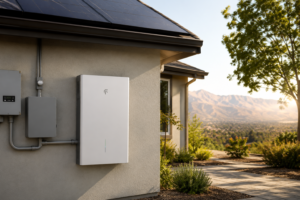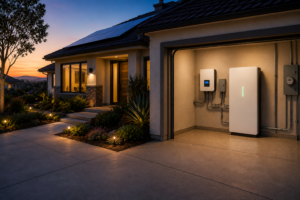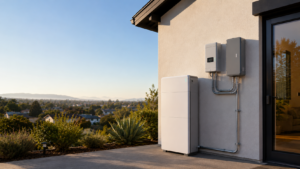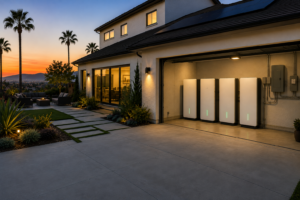
| Quick Answer: The FranklinWH aPower is the clean-retrofit specialist of California home batteries: its AC-coupled design works alongside most existing solar inverters regardless of brand or age, so adding storage does not mean rebuilding your solar installation. It stores 13.6 kWh per unit, delivers 5 kW continuous with 10 kW peak output, scales further than most residential platforms for larger homes, and carries a stated 12-year warranty. If you already have working panels from any manufacturer, it is usually the first platform to evaluate. |
Most California battery shopping happens in one specific situation: panels already on the roof, installed back when exported power was worth close to retail, now giving their best hours away for 5–8 cents under NEM 3.0. For that homeowner, the decisive question is not which battery is most famous — it is which battery joins the system you already paid for without tearing any of it out. That is the exact problem the FranklinWH aPower was built to solve.
Why AC-Coupling Is the aPower’s Defining Feature
The aPower is AC-coupled — it carries its own inversion onboard and connects on the AC side of your home’s electrical system, which means it works alongside most existing solar inverters rather than requiring them to be replaced. FranklinWH’s own product documentation confirms the AC-coupled architecture and the stable LFP (lithium iron phosphate) battery chemistry the platform is built on. If you have a working system on the roof already, that is the difference between adding a battery and rebuilding the whole installation.
aPower Specs at a Glance
- 13.6 kWh capacity per unit — a full evening of storage for a typical household.
- 5 kW continuous / 10 kW peak output — steady power for essential and mixed loads, with peak headroom for startup surges.
- Scales further than most residential platforms — larger homes and higher-consumption households add capacity without switching systems.
- Stated 12-year warranty — the longest stated warranty among the four platforms Solari Storage works with.
The output profile tells you the design philosophy: the aPower is tuned for storing a lot of energy and serving it steadily — the daily NEM 3.0 job — with scalability rather than single-unit output as its growth path. Homes needing maximum simultaneous output lean toward higher-output platforms; homes needing capacity, retrofit cleanliness and room to grow lean here.
The Retrofit Economics: Why Existing-Solar Homes Start Here
Adding a battery to an array that already exists is usually the cheapest energy upgrade available in California. The panels are paid for; the roof work is done; what is missing is somewhere to put the power until you need it. An AC-coupled aPower slots into that gap without touching the paid-for parts — your panels keep producing exactly what they always did, and the battery captures the midday generation you are currently exporting for 5–8 cents to spend it through the 35-to-62-cent evening peak. Compatibility with your specific inverter gets checked before anything is quoted, and you will be told if your system is one of the exceptions.
Who Should Choose the aPower — and Who Shouldn’t
Choose the aPower when you have existing solar from any manufacturer, when you want the longest stated warranty in the lineup, and when your home may need to scale capacity later. Look elsewhere in two clear cases: a SolarEdge inverter on the wall points to the DC-coupled SolarEdge Home Battery’s efficiency instead, and whole-home-backup ambitions built on heavy simultaneous loads point toward the highest-output platform. A four-platform specialist will tell you which — even when it is the cheaper one.
Getting an aPower Installed in California
Same honest path as any battery project: send a recent utility bill, get the system sized to your real evening load and backup priorities, have every currently open utility incentive verified and filed on your behalf, and let the project team manage the permits, the licensed-contractor installation and the utility interconnection. If your usage says the numbers do not work, you will hear that too — before you sign anything.
How the aPower Fits California’s 2026 Incentive Picture
The incentive landscape reset in 2026 — the federal residential tax credit ended after December 31, 2025, and SGIP is closed to general-market applications — which makes the retrofit economics the aPower specializes in matter more, not less. With no 30% federal cushion in the stack, the projects that pencil out are the lean ones: storage added to paid-for panels, sized to the real evening load, capturing the full spread between 5–8¢ exports and 35–62¢ peak imports every single day. That is precisely the AC-coupled retrofit profile, and it is why the cheapest-energy-upgrade framing carries more weight in 2026 than it ever did when a tax credit could paper over a bloated quote.
What remains on the table varies by utility and changes without much notice, so any incentive that appears in an aPower quote should be verified as currently open and applicable to your account — with the paperwork filed on your behalf so the money actually arrives. That verification, along with the permits, the licensed-contractor installation and the utility interconnection, is handled inside the standard five-stage process — and if a program is closed in your territory, you hear that before you sign, not after.
Frequently Asked Questions
Will the FranklinWH aPower work with my existing solar inverter?
Usually yes — its AC-coupled design works alongside most existing inverters regardless of brand or age. Compatibility is verified against your actual equipment before quoting, and exceptions are flagged honestly.
How much energy does the aPower store?
13.6 kWh per unit — and the platform scales further than most residential systems, so capacity grows by adding units rather than replacing the system.
What warranty does the aPower carry?
FranklinWH states a 12-year warranty — the longest stated warranty among the four platforms in the Solari lineup.
Is the aPower good for whole-home backup?
Its 5 kW continuous / 10 kW peak output serves essential and mixed loads well; whole-home designs with heavy simultaneous loads either scale up with additional units or point to a higher-output platform. The design follows your loads.
Why choose an AC-coupled battery over DC-coupled?
AC-coupling is what makes brand-agnostic retrofits possible — the battery joins your existing system rather than replacing its inverter. DC-coupling wins on efficiency when your equipment matches, notably with SolarEdge inverters.
Ready for a straight answer? Send Solari Storage a recent utility bill and find out exactly what a battery would do for your home — including if the numbers say don’t buy. Contact Solari Storage for a free assessment.
Key Takeaways
- The aPower’s AC-coupled design retrofits onto most existing solar — any brand, any age — without rebuilding the installation.
- 13.6 kWh per unit, 5 kW continuous / 10 kW peak, and a stated 12-year warranty — the longest in the lineup.
- It scales further than most residential platforms, making it the growth pick for larger and electrifying homes.
- Adding a battery to paid-for panels is usually California’s cheapest energy upgrade — and the aPower is built for exactly that move.
- SolarEdge-equipped homes and maximum-output whole-home designs are the two cases that point to other platforms.