| Quick Answer: Technically yes — a home battery can power any circuit in your house, including an EV charger. Practically, it is the wrong job for it: a typical home battery stores roughly 10–15 kWh while an EV pack holds several times that, so the battery would empty itself into the car for a partial charge. The winning setup in California is division of labor — the EV charges overnight on cheap off-peak grid rates, the home battery covers the expensive 4–9 PM peak, and both purchases happen at the cheapest possible hour. |
EVs and home batteries feel like natural partners — they are both big lithium packs, after all — and the question of whether one can fill the other comes up in almost every design conversation now. The honest answer has a “yes, but” structure, and the “but” is where the real money-saving strategy lives.
Can the Battery Physically Power an EV Charger?
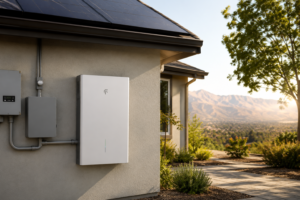
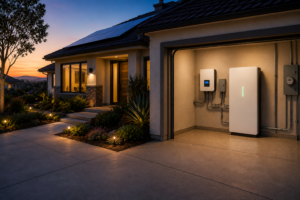
Yes. To the home’s electrical system, an EV charger is just another load, and a battery with sufficient output can run it the way it runs any circuit. Home Level 2 chargers commonly draw on the order of 7 to 11 kilowatts — a heavy but manageable load for higher-output platforms, and one that load control can manage alongside the rest of the house on others. Nothing about the physics says no.
Why Is It Usually the Wrong Use of Stored Energy?
Simple arithmetic. A home battery stores in the low tens of kilowatt-hours; an EV pack stores several times that. Draining the entire home battery into the car buys a modest slice of driving range and leaves the house with nothing for the evening peak — the exact hours the battery exists to cover. Stored home energy is most valuable displacing 35-to-62-cent peak electricity, not filling a tank that could have been filled overnight at the cheapest rate on your plan.
What Is the Smart EV-Plus-Battery Setup in California?
Division of labor across the rate clock:
- Midday: solar charges the home battery (and, if you are home, can feed the car directly with generation you would otherwise export for 5–8 cents).
- Evening (4–9 PM): the home battery carries the house through the most expensive hours; the EV waits.
- Overnight: the EV charges on the cheapest off-peak grid rates, without touching the home battery at all.
Every kilowatt-hour gets bought — or kept — at its cheapest possible hour. The U.S. Department of Energy’s primer on solar and storage describes the underlying logic: peak usage lands on summer afternoons and evenings exactly as solar output falls, and storage is what carries solar’s value into those hours. An EV simply adds one more big, schedulable load to arrange around that curve.
Does an EV Change How Big Your Home Battery Should Be?
Often, yes — not because the battery should charge the car, but because an EV household’s overall consumption and evening habits shift. If charging sometimes happens before 9 PM, or a second EV arrives, the evening load the battery must carry grows. This is precisely the scenario modular platforms exist for: the Lunar system is sized to your actual evening consumption and expandable later if you add an EV or electrify your heating — so the battery grows when the driveway does.
What About Backup — Can the Battery Charge the Car in an Outage?
It can, but in a real outage you almost certainly should not: range for the car comes at the cost of hours of household backup. Better designs put the EV charger on a managed or non-backed-up circuit so an outage automatically prioritizes the house, with the option to override deliberately if evacuating with a charged car matters more. That is a priorities conversation to have at the design stage — sized to your evening load and your backup priorities — not during the blackout.
What About Bidirectional Charging — Can the EV Power the House Instead?
It is the mirror-image question, and worth addressing squarely: some newer EVs and charging equipment support vehicle-to-home operation, letting the car’s much larger pack feed the house. The idea is genuinely promising — an EV holds several home-batteries’ worth of energy — but it depends entirely on having a compatible vehicle, compatible bidirectional equipment, and an installation designed for it, and the car can only back up a home while it is parked in the driveway with charge to spare. It complements a stationary battery more than it replaces one: the home battery works its rate-arbitrage shift every single day whether or not the car is home.
If a vehicle with bidirectional capability is in your plans, say so at the design stage — it affects charger selection, panel work and backup architecture, and it is far cheaper to accommodate on paper than to rewire for later. The design principle stays the same either way: every storage asset in the household, on wheels or on the wall, gets scheduled around the same rate clock, buying at the day’s cheapest hours and spending at its dearest.
Frequently Asked Questions
Can a home battery fully charge an EV?
No — EV packs hold several times what a home battery stores, so a full home battery translates to a partial charge at best. That is why overnight off-peak grid charging remains the EV’s natural fuel.
Can solar charge my EV directly?
If you are home during production hours, yes — and under NEM 3.0 it beats exporting that power for 5–8 cents. For commuters, the battery captures the midday value and the car charges off-peak overnight.
Should my EV charger be on backup circuits?
Usually not by default — an outage should prioritize the house. Designs can allow deliberate override when charging the car matters more, decided at the design stage.
Do I need a bigger battery if I buy an EV?
Sometimes — the trigger is whether your evening consumption grows, not the EV itself. Modular platforms expand when it does.
Does an EV change which rate plan I should be on?
It can — EV-oriented time-of-use plans deepen the overnight discount that makes the division-of-labor setup work. Rate plan review is part of reading your bill, which is where any honest design starts.
Ready for a straight answer? Send Solari Storage a recent utility bill and find out exactly what a battery would do for your home — including if the numbers say don’t buy. Contact Solari Storage for a free assessment.
Key Takeaways
- A home battery can power an EV charger, but its stored energy is worth more displacing 4–9 PM peak rates than filling a car.
- The winning setup is division of labor: solar fills the battery midday, the battery covers the evening, the EV charges off-peak overnight.
- An EV grows your household load — which affects battery sizing through your evening curve, and favors expandable platforms.
- Keep the EV charger off default backup circuits so outages prioritize the house, with deliberate override if you need it.
- The whole strategy is choreography around your rate plan — which is why it starts with your utility bill.