| Quick Answer: During a public safety power shutoff, a standard grid-tied solar system without storage shuts down completely and produces nothing, even in full sun, because it is required to disconnect to protect utility workers. Adding a battery allows the system to island from the grid and keep generating. Solari Storage installs Tesla Powerwall 3 and Lunar Energy systems configured for exactly this — call (916) 507-1626. |
It is the discovery that frustrates California solar owners more than any other: the power goes out during a hot, cloudless fire-weather afternoon, the panels are sitting in perfect sun, and the house is dark. This is not a fault and it is not bad luck. It is how a grid-tied system without storage is required to behave. Understanding why explains what you need to change if you want your array to work when the grid does not.
Why Do Solar Panels Shut Down in an Outage?
Solar panels shut down in an outage because a grid-tied inverter is required to disconnect when it detects the grid is down. This is called anti-islanding protection, and it exists to protect utility line workers who may be working on lines they have every reason to believe are dead.
If arrays kept exporting during an outage, they would energise sections of the distribution network unpredictably. So every grid-tied inverter shuts down automatically. The panels are perfectly capable of generating; the inverter simply will not let them, and there is no setting to override it.
What Is a PSPS and Why Does California Have Them?
A public safety power shutoff is a deliberate, pre-emptive de-energisation of distribution lines by a utility during high fire-risk conditions — typically hot, dry, windy weather. The intent is to prevent electrical infrastructure from starting a wildfire.
These events can last hours or several days, are announced with limited notice, and affect large areas. The CPUC’s public safety power shutoff resources explain how they are declared and how to check whether your address is affected. For homeowners, the important characteristic is duration: a PSPS is not a brief flicker, and planning for it is different from planning for a momentary outage.
How Does a Battery Change What Happens?
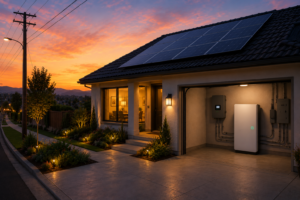
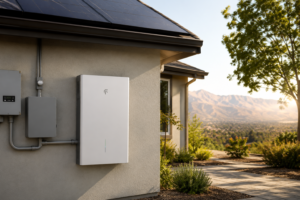
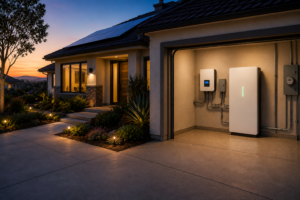
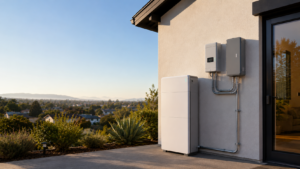
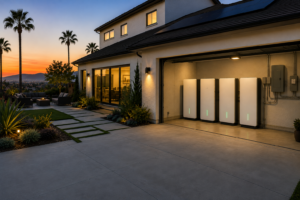
A solar-plus-storage system configured for backup can island — disconnect cleanly from the grid while continuing to operate as a self-contained system. Anti-islanding protection is satisfied because the system has physically separated from the distribution network.
Once islanded, your panels resume generating, the battery supplies the house, and surplus production recharges the battery rather than being exported. Solari Storage configures islanding at design stage for California homes in shutoff-prone areas. That combination is what turns an array from useless during an outage into the thing keeping your house running. Backup capability is a design decision made when the system is specified, not something added afterwards.
Can You Run for Several Days on Solar and Storage?
Frequently, yes — and PSPS conditions are unusually favourable for it. These events happen during hot, dry, sunny weather, which is when a solar array produces best.
A household running essential circuits can often cycle indefinitely: the array charges the battery through the day, the battery carries the house through the evening and overnight, and the cycle repeats the next morning. Whole-home backup with continuous air conditioning is a much harder ask and generally requires more capacity. Our guide to how long a battery runs your house in an outage covers the arithmetic behind that.
- PSPS events occur in sunny, dry conditions ideal for solar production
- Islanded systems recharge the battery from the array during daylight
- Essential-circuit backup can often cycle indefinitely across multi-day events
- Whole-home backup with climate control consumes capacity far faster
- Managing discretionary loads extends runtime substantially
Does Every Battery Provide Backup Automatically?
No, and this is a genuinely important distinction. A battery installed purely for bill management — charging off-peak and discharging at peak — does not necessarily include the equipment required to island and supply the house during an outage.
Backup requires additional hardware and a defined backup scope, whether that is a subpanel carrying essential circuits or a whole-home configuration. If outage resilience is part of why you are buying, it needs to be specified at design stage, which is why Solari Storage asks about it before sizing. It is a much more expensive change to make after installation than to include at the start.
There is a related distinction worth understanding. Some systems are configured to reserve a portion of their capacity specifically for outage protection, holding it back rather than discharging it for bill savings. That reserve is set as a percentage and can usually be adjusted seasonally — raising it through fire season and lowering it in months when shutoffs are unlikely. If outage resilience matters to you, ask how the reserve is configured and whether you can change it yourself.
What Should You Do Before the Next Fire Season?
Establish whether your address sits in an area subject to shutoffs, decide what you need running during a multi-day event, and confirm whether your existing system can island. Many California homeowners with solar assume they are covered and are not.
If you have an array and no storage, a retrofit is usually the cheapest route to resilience, because the panels and the roof work are already paid for. We only work in California, which means shutoffs and fire-season planning are a routine part of how we size systems rather than an edge case. Our about page explains why we stay in one state.
Frequently Asked Questions
Why won’t my solar panels work when the power is out?
Your solar panels will not work when the power is out because grid-tied inverters are required to shut down when the grid goes down, preventing your California system from energising lines utility workers may be repairing. Without a battery and islanding capability, the array cannot supply your house.
Will a battery automatically kick in during a PSPS?
A home battery kicks in automatically during a public safety power shutoff if the system is configured for backup. Switchover happens in a fraction of a second, fast enough that most household electronics do not register the interruption, and no action is required from you.
How much warning do you get before a PSPS?
California utilities aim to give advance notice of a public safety power shutoff, but notice periods can be short and forecasts change as weather conditions develop. Because timing is uncertain, resilience planning should not depend on having time to prepare.
Can I add backup capability to a battery I already have?
You can sometimes add backup capability to a battery you already have, but it depends on the equipment installed and how it was configured. It generally requires additional hardware and electrical work, and it is considerably cheaper to specify backup at the outset.
Is a generator better than a battery for a multi-day shutoff?
For a multi-day California shutoff, a generator runs as long as it has fuel but requires refuelling, maintenance and ventilation, while a solar-charged battery is silent, needs no fuel and recharges each day the sun shines — which during fire-weather shutoffs it reliably does.
Need help now? Call Solari Storage on (916) 507-1626 or send us a recent utility bill and we will come back with real numbers for your house.
Key Takeaways
- Grid-tied solar without storage produces nothing during an outage, because anti-islanding protection shuts the inverter down.
- A public safety power shutoff is a deliberate multi-hour or multi-day de-energisation during high fire-risk weather.
- A battery lets the system island from the grid, so panels resume generating and supply the house.
- PSPS conditions are hot, dry and sunny — unusually good for solar, which makes multi-day cycling realistic.
- Not every battery includes backup capability; islanding must be specified at design stage.
- For homes with existing panels, a storage retrofit is usually the cheapest route to outage resilience.
- Ask Solari Storage whether your system can island.