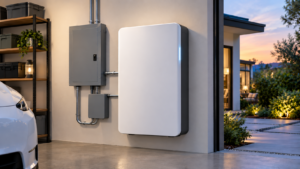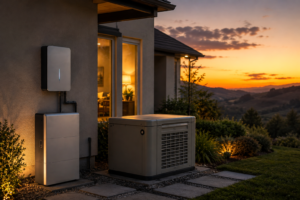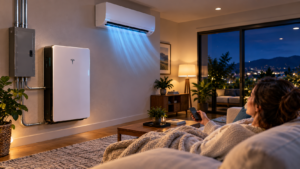
| Quick Answer: There is no single best home battery for California homes — there is a best battery for your house. Tesla Powerwall 3 leads on continuous output for whole-home backup, Lunar Energy sizes in modules to match your actual usage, FranklinWH aPower is the cleanest AC-coupled retrofit onto existing solar of any brand, and the SolarEdge Home Battery is the efficient choice if you already run a SolarEdge inverter. The deciding factors are your existing equipment, your loads, your backup priorities and your available incentives. |
Search for the best home battery and you will find a dozen listicles that all crown a winner — usually whichever battery the site’s owner happens to sell. That is the structural problem with most battery advice in California: when a company carries one platform, that platform is always the recommendation.
This comparison takes the opposite approach. Solari Storage works with four battery platforms specifically so the recommendation can follow the house rather than the sales sheet — including when the right answer is the cheaper one. Here is how the four actually differ, and the four factors that genuinely decide which one belongs on your wall.
Tesla Powerwall 3: The Proven Whole-Home Performer
The Tesla Powerwall 3 delivers 13.5 kWh of usable capacity with 11.5 kW of continuous output — the highest continuous output of the four platforms in this comparison, per Tesla’s published datasheet. That output number is what matters in an outage: it determines how many household loads the battery can carry at once, and 11.5 kW means running heavy circuits together rather than choosing which rooms stay live.
Powerwall 3 also brings Storm Watch, which monitors weather data and charges the battery ahead of forecast severe weather — so you enter an outage full rather than half-empty — and an integrated solar inverter option that keeps the equipment count down on a new system. Add the most polished app in the category and it is the default pick for whole-home backup.
Best for: whole-home backup, heavy simultaneous loads, and homeowners who want the most mature ecosystem.
Lunar Energy: Modular Sizing That Grows With You
The Lunar system spans 10 to 30 kWh with 9.6 kW of output, and its defining trait is modularity. Because capacity scales in increments rather than fixed blocks, the system gets sized to your actual evening consumption instead of rounding up to the next whole battery — and it can expand later if you add an EV or electrify your heating.
Lunar’s optimization software manages charge and discharge timing against your specific rate plan, and its load control lets you decide exactly what stays powered during an outage rather than treating the house as a single circuit. For households whose usage is going to change, it is the platform built for that.
Best for: precise sizing today with room to grow, and rate-plan-driven optimization.
FranklinWH aPower: The Clean Retrofit for Existing Solar
The FranklinWH aPower offers 13.6 kWh of capacity with 5 kW continuous and 10 kW peak output — and its decisive feature is that it is AC-coupled. It works alongside most existing solar inverters regardless of brand or age, rather than requiring them to be replaced. If you already have a working system on the roof, that is the difference between adding a battery and rebuilding the whole installation.
It also scales further than most residential platforms, so larger homes and higher-consumption households can add capacity without switching systems, and FranklinWH states a 12-year warranty on the unit — the longest stated warranty among these four.
Best for: adding storage to existing solar from any manufacturer, and larger homes that may scale up.
SolarEdge Home Battery: The Efficient Match for SolarEdge Homes
The SolarEdge Home Battery provides 9.7 kWh with 5 kW continuous and 7.5 kW peak output, and it is the obvious choice for one specific group: homes that already run a SolarEdge inverter. Its DC-coupled design avoids a conversion step that costs efficiency in AC-coupled retrofits, so more of the solar you generate ends up stored rather than lost in the round trip.
Monitoring runs through the SolarEdge platform you are already using, and that efficiency edge suits the daily grind of shifting energy against time-of-use rates — the use case that drives most of a California battery’s financial return — rather than only holding charge for outages.
Best for: homes with SolarEdge equipment installed, prioritizing round-trip efficiency and bill savings.
The Four Factors That Actually Decide It
Strip away the branding and the choice between these platforms comes down to four questions about your house, not the batteries:
- Your existing solar equipment. An existing inverter from another brand points toward AC-coupled FranklinWH; a SolarEdge inverter points toward SolarEdge; a brand-new system opens up Powerwall 3’s integrated inverter.
- Your household loads. Homes that need to run heavy circuits simultaneously in an outage lean toward higher continuous output; homes shifting evening usage lean toward efficiency and sizing precision.
- Your backup priorities. Whole-home backup, selected essential circuits, or maximum bill savings with minimal backup are three different designs — and they favor different platforms.
- Your utility and incentives. Available programs vary by utility territory and can shift which system pencils out best for your address.
All four inputs live in two places: your roof and your utility bill. That is why an honest recommendation starts with your actual bill and rate plan — not a satellite photo and a one-brand sales sheet — and why the answer is sometimes the cheaper battery, and occasionally no battery at all.
Frequently Asked Questions
Which home battery is best overall in 2026?
None of them, in general — they suit different houses. Powerwall 3 has the highest continuous output, Lunar scales in modules, FranklinWH retrofits cleanly onto existing solar, and SolarEdge is most efficient alongside a SolarEdge inverter.
Which battery has the most power output?
Among these four, Tesla Powerwall 3 at 11.5 kW continuous — enough to carry heavier simultaneous household loads during an outage. Lunar follows at 9.6 kW.
Which battery is best if I already have solar panels?
Usually the FranklinWH aPower, because its AC-coupled design works alongside most existing inverters regardless of brand or age — unless your inverter is SolarEdge, in which case the SolarEdge Home Battery’s DC-coupled efficiency is hard to beat. Compatibility gets checked before anything is quoted.
Which battery has the longest warranty?
FranklinWH states a 12-year warranty on the aPower, the longest stated warranty among these four platforms. Tesla publishes a 10-year warranty on Powerwall 3.
How do I find out which battery fits my house?
Send a recent utility bill. Your real usage, rate plan, existing equipment and backup priorities determine the platform — and if your home does not need what Solari Storage sells, you will be told so.
Ready for a straight answer? Send Solari Storage a recent utility bill and find out exactly what a battery would do for your home — including if the numbers say don’t buy. Contact Solari Storage for a free assessment.
Key Takeaways
- There is no universal best home battery — the right platform follows your equipment, loads, backup needs and utility.
- Tesla Powerwall 3: 13.5 kWh, 11.5 kW continuous — the whole-home backup benchmark with Storm Watch.
- Lunar Energy: 10–30 kWh modular — sized to your real evening usage and expandable later.
- FranklinWH aPower: AC-coupled 13.6 kWh with a stated 12-year warranty — the clean retrofit for any existing solar.
- SolarEdge Home Battery: DC-coupled 9.7 kWh — the efficiency pick for homes already running SolarEdge.
- A company selling one battery will always recommend that battery — a four-platform specialist can recommend the one your house needs.