| Quick Answer: Yes — most existing California solar arrays can take an AC-coupled battery regardless of inverter brand or age, and doing so is usually the cheapest energy upgrade available to a homeowner who already has panels. Solari Storage checks compatibility before quoting anything, so you are not paying for a survey to be told no. Call (916) 507-1626 or send us a recent utility bill and we will confirm what your system can accept. |
If your panels went up before 2023, they were sized and sold under rules that no longer exist. The array still produces exactly what it always did, but the value of what it exports has collapsed, and the obvious question is whether you can fix that without replacing everything. In almost all cases you can. This article explains how retrofitting storage to an existing array works, what determines compatibility, and why the economics of a retrofit are usually better than a new solar-plus-storage system.
Do You Need to Replace Your Panels to Add a Battery?
No. This is the most common misconception we encounter, and it stops people from making an upgrade that would benefit them. Your panels do not need replacing to add storage.
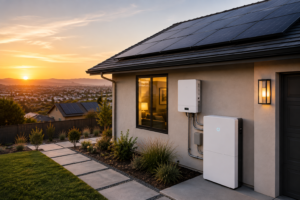
The mechanism is AC coupling. Rather than integrating with your existing solar inverter on the DC side, an AC-coupled battery connects on the alternating-current side of the system, which makes it largely indifferent to what brand or vintage your inverter is. That is why most existing systems can accept a battery even when the original installer is long gone and the equipment is a decade old.
Why Is a Retrofit Usually the Cheapest Upgrade?
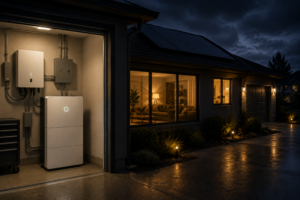
A battery retrofit is usually the cheapest energy upgrade available in California because the expensive parts are already paid for. The panels exist, the roof penetrations are done, the racking is up, and the interconnection is in place. What is missing is somewhere to put the power until you need it.
A new solar-plus-storage system carries the cost of the array, the roof work and the storage together. A retrofit carries only the storage, the electrical work to connect it, and the permitting. For a household with a functioning array on unfavourable export terms, that is typically the highest-return energy spend available. Our how it works page sets out the stages a retrofit runs through.
What Determines Whether Your System Is Compatible?
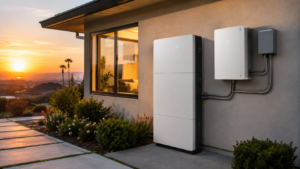
Compatibility is mostly about your electrical service and physical space rather than your panels. We check the condition and capacity of your main service panel, whether a subpanel is needed, where the battery can be sited, and how far that location sits from the panel.
Array size matters too, but not in the way people expect. A very large array does not require a proportionally large battery, because the battery is sized to your evening consumption rather than your midday production. Oversizing storage to match a big array is a common and expensive mistake.
- Main service panel capacity and condition
- Whether a subpanel is required for backed-up circuits
- Physical siting — garage, exterior wall, shade and clearances
- Distance and routing from the battery to the service panel
- Your evening load profile, which sets the capacity you actually need
Which Battery Suits a Retrofit Best?
Both systems we install work as retrofits, and the right one depends on your house rather than on a general ranking. The Tesla Powerwall 3 is published by Tesla at 13.5 kWh usable with 11.5 kW of continuous output, the highest continuous power output in its class, and it is the most-installed home battery in America.
Lunar Energy scales in modules rather than whole units, which can be an advantage when your evening load does not line up neatly with a single Powerwall’s capacity. Lunar was founded by a former Tesla Energy executive and states that its software optimises against your rate plan and the weather forecast. We sell both, and we recommend the cheaper one when the cheaper one is right.
Does a Retrofit Affect Your Existing NEM Agreement?
Adding storage to an existing California solar array can affect your interconnection agreement, and this is the question worth getting right before you commit. Adding storage to an existing system can, depending on how the modification is handled and which tariff you are on, trigger a review of your interconnection agreement.
For households on legacy NEM terms this matters a great deal, because those terms are valuable and you do not want to lose them by accident. The rules are set by your utility under frameworks published by the California Public Utilities Commission, and the handling differs by utility. We work through this before the design is finalised rather than discovering it at interconnection.
How Long Does a Battery Retrofit Take?
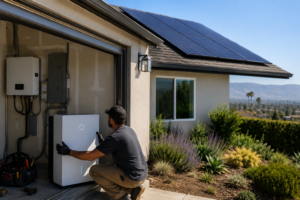
The installation itself is short — typically a day of on-site work for a straightforward single-battery retrofit, longer if panel upgrades are involved. The elapsed time is dominated by permitting and utility approval rather than by the physical work.
That is worth setting expectations around at the start, because homeowners often assume the calendar is driven by the installer’s schedule. In California it is usually driven by the city permitting office and the utility interconnection queue, and those timelines vary by jurisdiction.
Frequently Asked Questions
Will adding a battery void my solar panel warranty?
An AC-coupled battery retrofit does not typically interact with your solar panel warranty, because it connects downstream of the existing inverter rather than modifying the array. Inverter and workmanship warranties vary by manufacturer and original installer, so confirm your specific terms before work begins.
Can I add a battery if I don’t know who installed my solar?
Yes, you can add a battery to solar even if you do not know who installed it. AC coupling means the retrofit does not depend on the original installer’s records, so Solari Storage surveys what is physically on the property and designs from that.
Does my array need to be a certain size?
Your array does not need to be a particular size to accept a battery. Storage is sized to your evening consumption, not to your array, so small and large California systems can both take a battery. What changes is how much of the battery your own generation fills on a given day.
Can I add more capacity later?
With a modular battery system you can add capacity later, which is the main practical advantage of modular storage. With fixed-capacity units, expansion means adding a second unit, which involves additional electrical work, potentially further permitting, and cost.
Is a retrofit worth it if my panels are quite old?
A retrofit is often worth it even on an older array. A California system still producing well is exactly the case where storage shines, because the capital cost of the panels is long since sunk and the unfavourable export terms are what limit the return. Solari Storage checks production and condition during the survey.
Need help now? Call Solari Storage on (916) 507-1626 or send us a recent utility bill and we will come back with real numbers for your house.
Key Takeaways
- Most existing California solar arrays can accept an AC-coupled battery regardless of inverter brand or age.
- Your panels do not need replacing to add storage — AC coupling connects downstream of the existing inverter.
- A retrofit is usually the cheapest energy upgrade available because the panels, roof work and interconnection are already paid for.
- Compatibility depends mainly on your service panel, siting and evening load rather than on the array itself.
- Adding storage can affect an existing interconnection agreement, which matters most for households on legacy NEM terms.
- Ask Solari Storage to check your system’s compatibility.