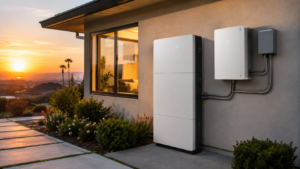
| Quick Answer: There is no single price for a home battery in California, because the final figure depends on usable capacity, how much work your electrical panel needs, and how far the battery sits from that panel. Solari Storage quotes from your actual utility bill rather than a satellite photo, so the number you get is the number you pay. Send us a recent bill and we will tell you what your house actually needs — including when the answer is a smaller system than you expected. |
Almost every California homeowner researching storage starts with the same question, and almost every website answers it with a range so wide it is useless. The honest answer is that the range is wide because the variables are genuinely large, and two houses on the same street can quote thousands apart for reasons that have nothing to do with the battery itself. What follows is a plain explanation of what actually drives the cost of a home battery in California in 2026, which incentives still exist, and how to work out your own number rather than someone else’s average.
What Actually Determines the Price of a Home Battery?
Three things set most of the cost: usable capacity, electrical panel work, and distance from the panel to the battery location. Everything else is comparatively minor.
Usable capacity is the obvious one. A Tesla Powerwall 3 is published by Tesla at 13.5 kWh usable with 11.5 kW of continuous output; a modular system scales in smaller increments, so you can land closer to what you actually need rather than rounding up to a whole unit. Buying more capacity than your evening load requires is the single most common way California homeowners overspend on storage.
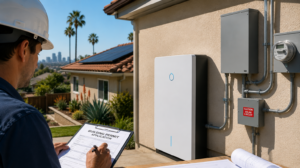
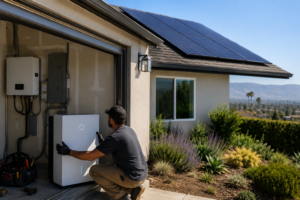
Panel work is the variable that surprises people. Older homes frequently need a main panel upgrade or a subpanel before a battery can be interconnected safely, and that work is priced by an electrician, not by the battery manufacturer. Distance matters for the same reason: every additional foot between the battery and the service panel is conduit, conductor and labour.
- Usable capacity of the system you choose
- Whether your main electrical panel needs upgrading
- Distance and routing between the battery and the panel
- Whether the install is a retrofit to existing solar or part of a new system
- Backup scope — whole-home versus essential circuits only
Is the 30% Federal Tax Credit Still Available in 2026?
No. Section 25D was repealed for anything installed after 31 December 2025, so a home battery bought and installed in 2026 does not qualify for the 30% federal residential clean energy credit. This is the single biggest change to California storage economics in years, and a large number of solar company websites have not updated their pages to reflect it.
Two details matter if you were partway through a purchase. First, the credit follows the date the installation was completed, not the date you paid a deposit — so a 2025 deposit on a 2026 install does not preserve it. Second, carryforward survives: if you installed in 2025 and could not use the full credit against that year’s tax bill, the unused portion carries forward. The IRS is the authority on your own position, and you should confirm it with a qualified tax professional. Solari Storage installs batteries; we are not tax advisers.
Does SGIP Still Reduce What You Pay?
For most California homeowners in 2026, SGIP no longer reduces what a home battery costs. California’s Self-Generation Incentive Program pays up to $1,000 per kWh toward battery storage — enough to cover a substantial share of an install — but the general market, equity and equity resiliency budgets are closed to new applications. Only the income-qualified RSSE budget is still accepting applicants, and it is running a waitlist.
If there is a chance you qualify, the application is worth making, and we file it on your behalf rather than pointing you at a website. If you do not qualify, we say so and leave it out of your quote entirely. A rebate written into a quote that never arrives is not a discount; it is a number that makes the paperwork look better than the outcome.
Why Do Quotes From Different Companies Vary So Much?
Home battery quotes across California vary so much because most of them are not measuring the same thing. A quote generated from a satellite image and a roof size is estimating; a quote built from your actual utility bill and a look at your service panel is measuring. The two will diverge, and the estimate is the one that changes after the site visit.
Scope is the other reason. A whole-home backup configuration and an essential-circuits configuration are very different pieces of electrical work, and a headline price that does not state which one it covers is not comparable to one that does. When you are comparing quotes, check what each one assumes about panel work, backup scope and permitting — that is usually where the gap lives.
What Does a Battery Save You Each Month?
The saving comes from the gap between what your utility pays you for exported power and what it charges you at peak. Under NEM 3.0, exported power earns roughly a quarter of what it used to, while summer peak rates run into the high fifties and low sixties of cents per kWh depending on your utility and tariff.
That means the value of a battery is set by your rate plan and your evening usage, not by the size of your roof. A household that is out all day and runs air conditioning from four until nine in the evening captures far more value than one with low evening load. Our NEM 3.0 explainer walks through the arithmetic in detail.
How Do You Get a Real Number for Your House?
Send a recent utility bill. That single document tells us your utility, your rate plan, your usage pattern and your export credit, which between them determine both the right system size and the value it will deliver.
From there the process is straightforward: we review the bill, size the system honestly, confirm what your panel needs, and quote the whole job including permitting and interconnection. If the numbers say a battery is not worth it for your house, we tell you that too. It is a shorter conversation, but it is the right one.
Frequently Asked Questions
Is a home battery cheaper if I already have solar panels?
Adding a battery to solar panels you already have is usually cheaper than a new solar-plus-storage system, because the panels and the roof work are already paid for. Most existing California arrays can accept an AC-coupled battery regardless of inverter brand or age. Solari Storage checks compatibility before quoting.
Does a bigger battery always save more money?
No. Beyond the point where a home battery covers your evening peak usage, extra capacity sits unused most days and adds cost without adding saving. The right size in California is set by your evening load and your time-of-use rate plan, which is why Solari Storage starts with your bill rather than your roof.
Are there financing options for home battery storage?
Financing for home battery storage is available in the California market through various lenders and programmes, and terms vary considerably. The sensible order is to establish what the system should cost first and how it will be paid for second. Solari Storage can talk through what is available at the point of quoting.
Do battery prices change through the year?
Equipment pricing moves with supply and manufacturer programmes, and installation labour moves with demand. For most California homeowners the larger swing is not the equipment but the electrical work their particular house needs, which does not follow a seasonal pattern.
Will a battery pay for itself?
Whether a home battery pays for itself in California depends on your utility, your tariff and your evening usage. For households on high time-of-use rates with significant evening consumption, the arithmetic is strong; for low-usage households on flatter rates it can be weak. Solari Storage runs your actual numbers and tells you which one you are.
Need help now? Call Solari Storage on (916) 507-1626 or send us a recent utility bill and we will come back with real numbers for your house.
Key Takeaways
- Home battery cost in California is driven by usable capacity, electrical panel work and distance from the panel — not by a standard price list.
- The 30% federal credit under Section 25D was repealed for installs completed after 31 December 2025 and has not been replaced.
- SGIP still pays up to $1,000 per kWh, but only the income-qualified RSSE budget remains open, and it is waitlisted.
- Quotes vary widely because some measure your actual bill and panel while others estimate from a satellite image.
- The saving a battery delivers depends on your rate plan and evening usage, not the size of your roof.
- Send Solari Storage a recent utility bill for real figures for your house.